Every parent knows this moment.
You let go of their hand. You trust the adults inside.
How do you know the children in your care are safe, or do you just believe it?
Good intentions aren't enough. Safe by Design, the book and the workbook give parents and the people they trust a way to check, not just hope. Start with an honest answer. Nobody's grading you.
Free. Private. About [MINUTES] minutes. Your answers stay on your device.
What's behind that closed door?
8 Hidden Gaps in Good Programs
These show up in well-run schools, teams, churches and youth programs, run by people who genuinely care. That's what makes them hidden: everyone assumes someone else has it covered.
Tap any gap that could be true where your child goes.
Gap 1: The policy exists, but nobody can use it in the moment.
It lives in a binder. Ask a volunteer what it says about private messages with a child and watch them reach for the shelf.
Ask for valid proof: Can a newer volunteer tell me what to do if a child asks to message them privately?
Gap 2: Screening happened once.
The adult who's "just helping out today" was never checked, and nobody compares clearances against who is actually working.
Ask for valid proof: Who is with children today, and does every one of them have the checks their role requires?
Gap 3: Two names on the schedule, one adult in the room.
It happens at late pickup, in the equipment room, and whenever someone steps out "for a second."
Ask for valid proof: Has anyone checked, at pickup time, that two adults are actually there?
Gap 4: Watched an awareness video, no critical-moment practice.
Nobody has rehearsed what to say, and what never to promise, when a child tells them something.
Ask for valid proof: Has someone watched staff practice a realistic disclosure and given them feedback?
Gap 5: Speaking up is encouraged, until someone does.
The first person to raise a concern about a popular adult quietly loses shifts, standing or friends. Everyone else takes note.
Ask for valid proof: What happened to the last person who raised a concern?
Gap 6: The reporting route runs through the person it might be about.
Every concern goes to the director or pastor, with no route around them.
Ask for valid proof: If the concern were about the person in charge, where would it go?
Gap 7: Safeguards cover the main room only.
Not the side door, the car ride home, the changing area or the team group chat.
Ask for valid proof: Can you show me the plan for rides, changing and online contact?
Gap 8: No systematic follow-up to spot new gaps.
New risks arrive faster than policies change, like digital communication boundaries for the latest app or group chat. Nobody is assigned to look.
Ask for valid proof: When did someone last check for new risks, and what did they find?
0 of 8
Tap any gap that might be true.
Not sure? Count it. "I don't know" is a gap too, just one you haven't checked yet.
Valid proof comes from what you canreadaskwatchtry outhear from childrenand the more of these agree, the more you can trust it.
Eight keys. One arch.
An arch only stands when every stone is in place. Pick a key to see what valid proof looks like, then see what happens when it's missing.
Key 3
Two-deep leadership
Two adults, actually supervising, on an ordinary tired Tuesday.
What valid proof looks like
Someone checks at pickup time and finds two adults actually present and in sight of each other, not just two names on a schedule.
Where are you starting from?
Same eight keys for everyone. Different questions, because you have different roles, authority and access.
- Parents and caregiversEight questions to ask before you hand over your child, and what a good answer sounds like.Start here
- Teachers and coachesWhat to say if a student tells you something, and a five-minute boundary check.Start here
- Social workersA shared vocabulary for what the evidence does and doesn't show.Start here
- Leaders and boardsA first-90-days plan and the questions to ask before calling anything "done."Start here
- Government and policyEvidence over attestation, the sources behind the tool, and how to pilot it responsibly.Start here
Safeguards live in ordinary places.
- [PHOTO: an empty gym after practice, lights half off]
The gym after everyone's gone - [PHOTO: a propped-open side door]
The side door everyone uses - [PHOTO: a sign-in clipboard on a counter]
The sign-in sheet - [PHOTO: a car idling at a pickup curb at dusk]
The late pickup
Three steps. Start wherever you are.
Ask the questions
Pick your role and ask one question per key. "Can you give me an example?" does most of the work.
Take the assessment
Free for individuals and private by design. Teams can compare views: $99 per organization plus $49 per seat.
See how it worksGo deeper with the book
Follow one program through a year of getting it wrong, then right, one key at a time.
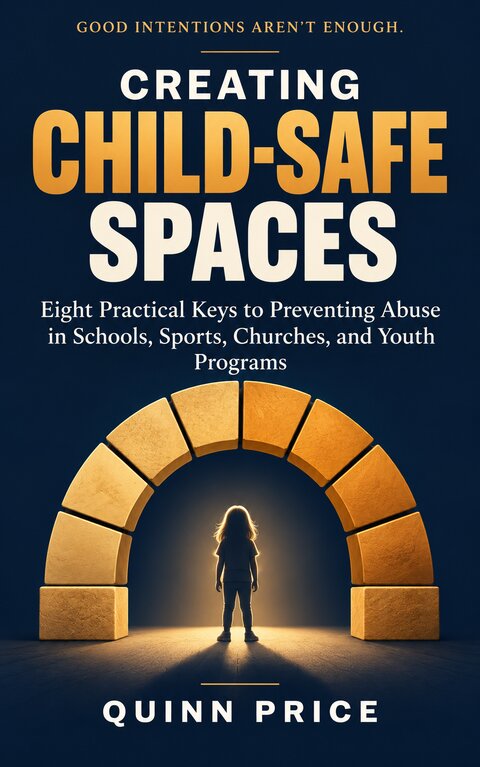
The book behind the assessment
Creating Child-Safe Spaces
Eight Practical Keys to Preventing Abuse in Schools, Sports, Churches, and Youth Programs
By Quinn Price, drawing on four decades of helping organizations close the gap between what they intend and what actually happens.
Worried about a child right now?
Don't wait for an assessment, a meeting, or proof. Protection comes first.
Reporting rules differ by place. Check the requirements where you live or work.